Showing posts with label palm tree. Show all posts

29 December 2014


Classic car in Colonia del Sacramento, Uruguay

Colonia del Sacramento

Colonia del Sacramento (formerly the Portuguese Colónia do Sacramento) is a city in southwestern Uruguay, by the Río de la Plata, facing Buenos Aires, Argentina. It is one of the oldest towns in Uruguay and capital of the Colonia Department. It has a population of around 27,000.

It is renowned for its historic quarter, a World Heritage Site. Modern Colonia del Sacramento produces textiles and has a free trade zone, in addition to a polytechnic centre and various government buildings.

History

Founded in 1680 by Portugal as Colónia do Sacramento, the colony was later disputed by the Spanish who settled on the opposite bank of the river at Buenos Aires. The colony was conquered by José de Garro in 1680, but returned to Portugal the next year. It was conquered again by the Spanish in March 1705 after a siege of five months, but given back in the Treaty of Utrecht. Another attack during the Spanish-Portuguese War, 1735-1737, failed.

It kept changing hands from crown to crown due to treaties such as the Treaty of Madrid in 1750 and the Treaty of San Ildefonso in 1777, until it remained with the Spanish. It then transferred to Portuguese control again, being later incorporated into Brazil after 1816, when the entire Banda Oriental (Uruguay) was seized by the government of the United Kingdom of Portugal, Brazil and the Algarves and renamed the Cisplatina province.

On 10 January 1809, before the independence of Uruguay, it was designated as a "Villa" (town) and has since been elevated to the status of "Ciudad" (city).

Since independence Colonia del Sacramento has expanded to the north and east, but the original Barrio Histórico (historic quarter) retains its irregular, terrain-fitting street plan built by the Portuguese, contrasting with the wider, orthogonal calles in the newer Spanish area.

See: wikipedia


19 December 2014


Palm tree and lighthouse in Colonia del Sacramento, Uruguay

Colonia del Sacramento

Colonia del Sacramento (formerly the Portuguese Colónia do Sacramento) is a city in southwestern Uruguay, by the Río de la Plata, facing Buenos Aires, Argentina. It is one of the oldest towns in Uruguay and capital of the Colonia Department. It has a population of around 27,000.

It is renowned for its historic quarter, a World Heritage Site. Modern Colonia del Sacramento produces textiles and has a free trade zone, in addition to a polytechnic centre and various government buildings.

History

Founded in 1680 by Portugal as Colónia do Sacramento, the colony was later disputed by the Spanish who settled on the opposite bank of the river at Buenos Aires. The colony was conquered by José de Garro in 1680, but returned to Portugal the next year. It was conquered again by the Spanish in March 1705 after a siege of five months, but given back in the Treaty of Utrecht. Another attack during the Spanish-Portuguese War, 1735-1737, failed.

It kept changing hands from crown to crown due to treaties such as the Treaty of Madrid in 1750 and the Treaty of San Ildefonso in 1777, until it remained with the Spanish. It then transferred to Portuguese control again, being later incorporated into Brazil after 1816, when the entire Banda Oriental (Uruguay) was seized by the government of the United Kingdom of Portugal, Brazil and the Algarves and renamed the Cisplatina province.

On 10 January 1809, before the independence of Uruguay, it was designated as a "Villa" (town) and has since been elevated to the status of "Ciudad" (city).

Since independence Colonia del Sacramento has expanded to the north and east, but the original Barrio Histórico (historic quarter) retains its irregular, terrain-fitting street plan built by the Portuguese, contrasting with the wider, orthogonal calles in the newer Spanish area.

See: wikipedia


02 June 2014


Panorama in Colonia, Uruguay

Colonia del Sacramento

Colonia del Sacramento (formerly the Portuguese Colónia do Sacramento) is a city in southwestern Uruguay, by the Río de la Plata, facing Buenos Aires, Argentina. It is one of the oldest towns in Uruguay and capital of the Colonia Department. It has a population of around 27,000.

It is renowned for its historic quarter, a World Heritage Site. Modern Colonia del Sacramento produces textiles and has a free trade zone, in addition to a polytechnic centre and various government buildings.

History

Founded in 1680 by Portugal as Colónia do Sacramento, the colony was later disputed by the Spanish who settled on the opposite bank of the river at Buenos Aires. The colony was conquered by José de Garro in 1680, but returned to Portugal the next year. It was conquered again by the Spanish in March 1705 after a siege of five months, but given back in the Treaty of Utrecht. Another attack during the Spanish-Portuguese War, 1735-1737, failed.

It kept changing hands from crown to crown due to treaties such as the Treaty of Madrid in 1750 and the Treaty of San Ildefonso in 1777, until it remained with the Spanish. It then transferred to Portuguese control again, being later incorporated into Brazil after 1816, when the entire Banda Oriental (Uruguay) was seized by the government of the United Kingdom of Portugal, Brazil and the Algarves and renamed the Cisplatina province.

On 10 January 1809, before the independence of Uruguay, it was designated as a "Villa" (town) and has since been elevated to the status of "Ciudad" (city).

Since independence Colonia del Sacramento has expanded to the north and east, but the original Barrio Histórico (historic quarter) retains its irregular, terrain-fitting street plan built by the Portuguese, contrasting with the wider, orthogonal calles in the newer Spanish area.

See: wikipedia


19 May 2014


Palm tree (2007) - Elizabeth Titton

Elizabeth Titton

Artist born in São Paulo (1949), but living in Curitiba since 1957. Graduated in Business Administration from the Federal University of Paraná (UFPR, 1973) and in Painting from the School of Music and Fine Arts of Paraná (EMBAP, 1982).

Training Specialist Hospital Executives UFPR (1975) and in Sociology and Economics (Historical Perspectives Contemporary) from the Pontifical Catholic University of Paraná (PUC-PR, 1988) and a Master of Education UFPR (2000). Was director (1984-1987) and a member of the Advisory Board (2007) Museum of Contemporary Art of Paraná (PR-MAC).

Creator of the "Pro-Build" (1988), an institution that still manages cultural space. In the 1970s and 1980s, attended different courses of artistic improvement and sculpture workshop (under the direction of Benito Elvo Damo) Creativity Center in Curitiba. Since 1990, teaches in Studied sculpture EMBAP.

Has been active in several associations and councils of institutions dedicated to the promotion and preservation of the art in Curitiba.

See: galeriatitton


22 March 2014


Executive Tower, Montevideo

Torre Ejecutiva, Montevideo

Executive Tower is the name of the working place of the President of Uruguay. The original project was started in 1965 as a future Palace of Justice, but the 1973 coup d'état interrupted it.

By the time the military government ended in 1985, the building was too small for the Uruguayan justice system, so the project remained halted for decades until in March 2006, President Tabaré Vázquez decided to finish the building and use it as an extension of the Estévez Palace. The President's offices were transferred there from the Liberty Building in September 2009.

Despite the name, the building does not actually belong to the Presidency of Uruguay, but to a fully government-owned company called Legader S.A., which is in charge of leasing office space to other public and private organizations to finance the works on the building.

See: wikipedia


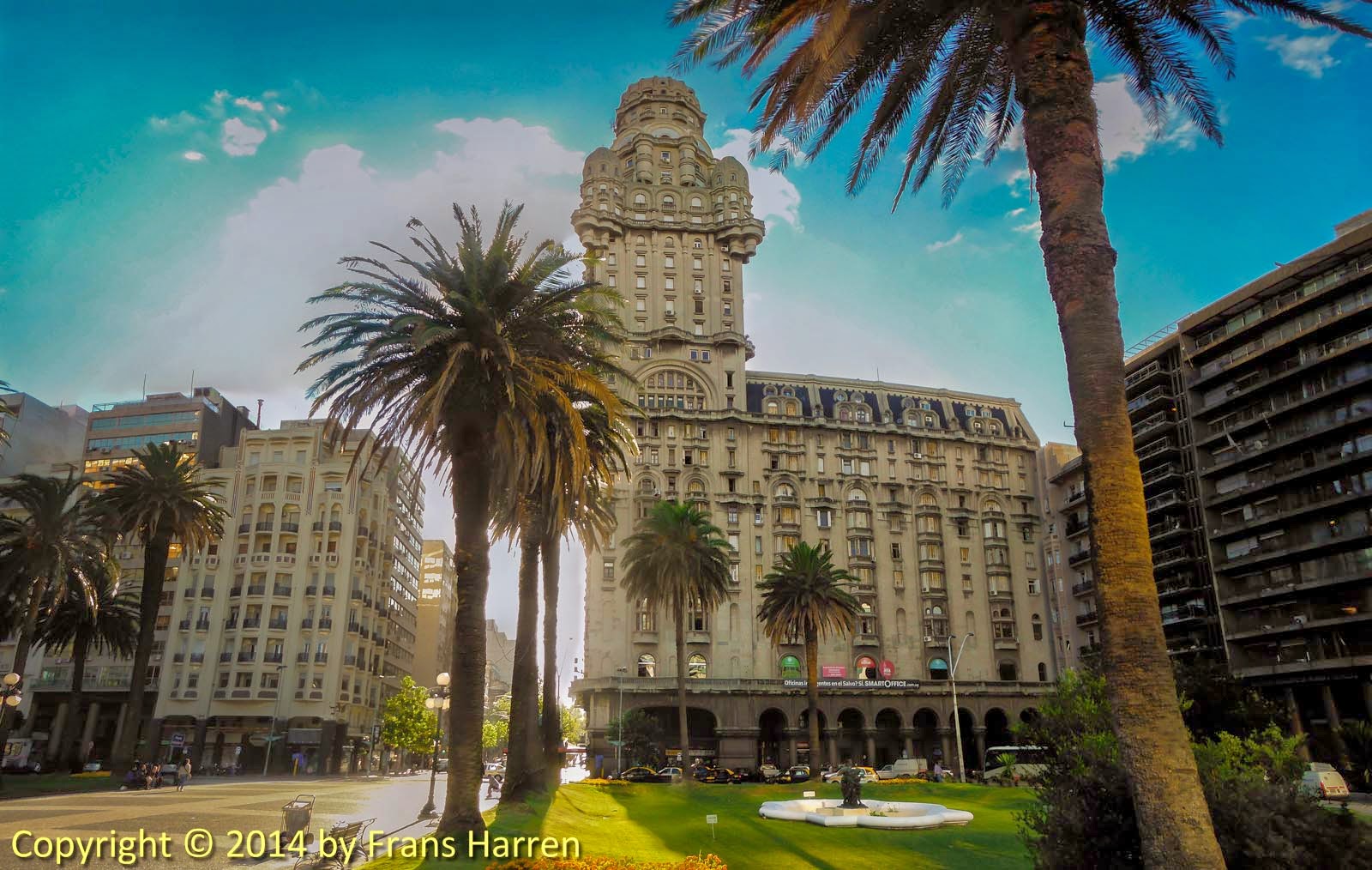
Palacio Salvo, Montevideo

Palacio Salvo

Salvo Palace is a building in Montevideo, Uruguay, located at the intersection of 18 de Julio Avenue and Plaza Independencia. It was designed by the architect Mario Palanti, an Italian immigrant living in Buenos Aires, who used a similar design for his Palacio Barolo in Buenos Aires, Argentina. Finished in 1928, Palacio Salvo stands 100 meter high with the antenna included.

The site was bought by the Salvo brothers for 650,000 Uruguayan pesos. It was built on the site where the Confiteria La Giralda was once located, a place renowned for being where Gerardo Matos Rodríguez wrote his tango La Cumparsita in 1917.

The original specifications, describing the details of the construction, describe a lighthouse at the top of the building, which was replaced by a set of antennas. The specifications stated “on the top part of the tower a lighthouse will be placed made by Salmoiraghi of Italy, with a parabolic mirror of 920 mm, reaching approximately 100 km, and a rotating 100 amp lamp”.

The building was originally intended to be a hotel, but this plan didn't work out, and it has since been occupied by a mixture of offices and private residences. The building has a height of 95 meter. While the set of antennas was at its top, its total height was 100 meter. The antennas were permanently removed in November 2012. For decades it was the tallest building in South America.

See: wikipedia


24 August 2013


Iglesia de Nuestra Señora de los Remedios
Plaza Nuestra Señora de los Remedios

Yaiza

Yaiza is a municipality of Las Palmas province, in Lanzarote on the Canary Islands, Spain. It is in the southwest of the island of Lanzarote. It is also a town within the municipality as described above.

With recently (2011) tree-lined roads, the town houses a townhall and has a floodlit public football stadium. Yaiza is famous for its 2 major towns, Puerto Calero, Playa Blanca and the lagoon of Charco Verde which features a green pond and colorful rims (located adjacent to El Golfo). The lagoon itself is fenced off, although there is a path that leads to black sands, across which you can reach the lagoon fencing. Part of the land to the north is part of the Timanfaya National Park.

Each year, at Christmas, Yaiza displays a large "Belén". A belén is a nativity scene, but that also includes miniaturised scenes from around the Island. This particular one features miniature Playa Blanca, Arrecife, and Timanfaya, as well as most other features of the Island. Children and visitors are encouraged to seek the figurine of a young man defecating, as it is considered good luck to spot him.

The population is 9,664 (ISTAC, 2006), its density is 36.78/km² and the area is 211.84 km². It is located on a main highway linking Yaiza (the town)and Teguise as well as east to Arrecife. It is the westernmost and the southernmost terminus of LZ3. The main industries are agriculture and tourism especially in the park area. The Atlantic Ocean is to the west and north, the mountains are to the south, central and the eastern part. Farmlands along with barren lands dominate the rest of the municipality.

Yaiza is the only municipality in Lanzarote to contain two Marinas: Rubicon Marina at Playa Blanca, and Puerto Calero. Its largest town is Playa Blanca, at its southernmost edge.

See: Wikipedia

Lanzarote

Exotically arid and desert-like, Lanzarote is a striking volcanic island 130 kilometers off of the coast of Africa and 1,000 kilometers from the Iberian Peninsula. Comprising one of the Canary Islands, its capital is Arrecife, with 140,000 residents. Lanzarote enjoys a warm, welcoming year-round climate that varies little throughout the year.

What do Lanzarote vacations have to offer?

  • A Beach for Everyone in Lanzarote. Beach lovers will find Lanzarote to be a true paradise. This island showcases white, gold, and black sand beaches, most of which have tranquil waters. Others enjoy larger waves that are ideal for watersports such as surfing or windsurfing.
  • Biosphere Reserve Island. One of Lanzarote's premiere tourist attractions is its spectacular natural beauty: landscape, volcanoes, endangered species, etc. Lanzarote's natural wonders even earned UNESCO's distinguished title of "Biosphere Reserve" in 1993.
  • Lanzarote Gastronomy. Simplicity is the key factor in Lanzarote's delicious cuisine. The high quality of the primary ingredients results in flavorful dishes that are sure to both surprise and please. Traditional foods of the region include sancocho, papas arrugadas, and panes de maní.

Beaches

Lanzarote’s beaches run along the 190km coastline and, despite being a destination popular with holidaymakers, they offer unspoiled landscapes. Lanzarote’s beaches are divided into six zones, each one with its own characteristics. The beaches on the south deserve special mention: Yaiza and the huge marina area of Playa Blanca.

Main beaches in Lanzarote

  • Yaiza beaches: In the south of Lanzarote, Yaiza beaches have the largest marina on the island, Playa Blanca. The most beautiful beaches are Papagayo, with fine golden sand, Flamingo, Janubio, in a protected natural area, Montaña Roja and Las Coloradas, which has managed to preserve its wild natural beauty.
  • Arrecife beaches: The beaches in the capital of Lanzarote offer excellent facilities and services. One of their advantages is that they are virtually part of the city. El Reducto is considered to be the best, since it has fine white sand, calm waters and a nice sea promenade. La Concha, beyond city borders, is excellent too.
  • Teguise beaches: The coastline in Teguise gathers numerous beaches that welcome surfers and windsurfers, as they are the windiest in Lanzarote along with those in Tinajo. Las Cucharas is among the best known, as are El Jablillo or Los Charcos. Farama is the longest (6km) but too many high waves make it bad for swimming.
  • Beaches in the north of Lanzarote: In the northern part of Lanzarote are Haría and La Graciosa, in the Chinijo archipelago, which has bright unspoilt beaches of fine white sand like La Laja, El Salado or Francesa.

Local feasts

Lanzarote has feasts all year round, but it is in the summer that the most important and traditional ones take place. In June and September, Lanzarote commemorates its patron saints in Haría or Yaiza, with the procession of Los Remedios. Local fiestas are the perfect time to get to know the character and culture of the island people.

Major events in Lanzarote

  • La Candelaria: It is held in February in Tías and is the oldest fiesta, since it dates to the years following the Reconquista. They eat fried pork with gofio and traditional cheese, and watch Canary wrestling tournaments, regional dance shows and other folk traditions.
  • Carnival in Lanzarote: Carnival is the main festival in the Canaries, especially in Lanzarote, although in Tenerife or Gran Canaria celebrations are somewhat brighter. In Arrecife, it gathers big crowds and ends with the Burial of the Sardine and a fireworks show.
  • Feast of San Antonio: Tías gets all dressed up on 13 June to honour Saint Anthony. Music, processions and activities for kids and adults abound during this feast day. In Lanzarote they believe it is the perfect day to find someone to marry, since Saint Anthony is the matchmaker saint.
  • Feast of El Carmen: The Virgin of El Carmen is the Patroness of the coast of Teguise, a village where Her feast is held annually on 16 July. Processions at sea are the main activity, and the most picturesque too, as a great number of boats decorated with colourful flowers sail down the coast. Thousands of enthusiastic visitors come to Teguise every year to attend this feast in July.
  • San Bartolomé Festival: On 24 August, San Bartolomé, a town situated in the centre of the island of Lanzarote, celebrates the feast honouring its patron saint. This folk festival is perfect to learn about the history and culture of Lanzarote.
  • Saint Ginés in Arrecife: The major feasts in the capital of Lanzarote last two weeks but the real feast day is 25 August. Traditional dance, meals, processions and parties follow right after the other non-stop, attracting huge crowds. The area of El Reducto beach becomes a great leisure and fun venue.
  • Virgin of Los Remedios Feast: On 8 September every year, Yaiza honours its Patroness with a charming procession filled with symbols. Sports, theatre plays, exhibitions, traditional dance... Activities for the whole week ending with a big water festival and a traditional cookout.

Natural areas

The island of Lanzarote is a display of natural beauty you will not find anywhere else in the Canaries. Huge areas of volcanic soils, craters and hard lava live together with crop fields. More than 40% of the island is protected and, in fact, Lanzarote as a whole has been designated a Biosphere Reserve by UNESCO.

Nature in Lanzarote:

  • Timanfaya National Park: Timanfaya is the best-known natural area in Lanzarote, between Yaiza to the south and Tinajo on the west coast. With 50km², the park covers a good area of the south-western part of the island, where the volcanic landscapes are fantastic. There are as many as 25 volcanoes in the park, Montañas del Fuego (Fire Mountains) among them.
  • Los Ajaches: Los Ajaches is one of the most important natural areas in Yaiza, south Lanzarote. It is a huge volcanic massif spanning over 3,000ha that offers a spectacular landscape of contrasts and signposted hiking trails.
  • Naturists’ cave: This is an outstanding cave in Lanzarote, between Tías and Tinajo, in the protected natural area of La Geria. It has volcanic origin and forms a huge underground passage with galleries and chambers of great beauty. It covers 2.1ha.
  • Los Hervideros: It has a wonderful rugged coast with impressive cliffs in reddish and purple volcanic rock worn away by the sea in the area of Janubio. There are underwater caves that offer a nice show to scuba divers.
  • Saline marshes in Janubio: Close to Los Hervideros, in Janubio Nature Park, there are the beautiful saline marshes, covering nearly 500,000m². The central element is a big highly concentrated salt lake, whose salt is used in cooking.
  • Charco Verde: Also known as Charco de los Clicos, it is a lagoon by the charming coastal town of El Golfo. While still in Lanzarote, it is out of this world. A natural lake on a big black sand beach in the middle of a crater up a volcanic mountain. The lake is fed by seawater and gets its green colour from algae.

Curious facts

Curious facts and stories about Lanzarote have to do, most often than not, with its impressive volcanic landscapes. The volcanic island keeps secrets and stories that have come down to us from the aboriginal inhabitants, the Guanches, who have adapted themselves to new conditions while retaining their genuine roots.

History of Lanzarote and curious facts:

  • Mirror of the Moon: Timanfaya Park in Lanzarote looks exactly like the Moon. They say that Apollo astronauts looked at pictures of this park to get an idea of what the surface of the Moon would look like.
  • Lanzarote in film: The stunning landscapes of Lanzarote were chosen by film directors as scenery for blockbusters like Moby Dick, When Dinosaurs Ruled the Earth, Doctor Who and Almodovar’s Los abrazos rotos/Broken Embraces, and for TV series like Search for Treasure Island.
  • Island of volcanoes: Lanzarote, with Timanfaya and Los Volcanes Parks, is the area with the highest concentration of volcanoes (25) across Spain. The latest eruptions took place in the eighteenth century, destroying numerous villages in the area of Montañas del Fuego.
  • More than a million visitors: With a population of 140,000, Lanzarote attracts more than a million visitors a year.
  • The other capital: Teguise was formerly the capital of the island. Today, the capital is Arrecife, a busy city that hosts government and administrative buildings.
  • From Genoa: The name Lanzarote, historians say, comes from the name of a Genoese sailor, Lancelotto Malocello, who came to the island in the fourteenth century. The castle of Guanapay – the oldest on the island – was erected over a tower belonging to Malocello.
  • Clicos: The wonderful green lagoon of El Golfo is also known as Charco de los Clicos because it used to be home to a crustacean, clico, that has been extinct for over a century now.

See: Wikipedia


Panorama of Bodega El Grifo and Wine Museum
Bodega El Grifo and Wine Museum
Flowering cactus
Lanzarote
Fields of Lanzarote
Panorama of cactus field

Bodega El Grifo and Wine Museum

The Wine Museum is located in the old cellar facilities, built on volcanic lava in the 18th century.

The entrance is via the Monument to the Griffon (Monumento al Pájaro Grifo), sculpted by César Manrique.

Visited by 60,000 persons each year.

The antique utensils and wine-making machinery (wine presses, pumps, crushers, stills, barrel workshop…) are from the 19th and beginning of the 20th century.

The Wine library contains 5,000 titles.

See: elgrifo, lanzaroteinformation

Lanzarote

Exotically arid and desert-like, Lanzarote is a striking volcanic island 130 kilometers off of the coast of Africa and 1,000 kilometers from the Iberian Peninsula. Comprising one of the Canary Islands, its capital is Arrecife, with 140,000 residents. Lanzarote enjoys a warm, welcoming year-round climate that varies little throughout the year.

What do Lanzarote vacations have to offer?

  • A Beach for Everyone in Lanzarote. Beach lovers will find Lanzarote to be a true paradise. This island showcases white, gold, and black sand beaches, most of which have tranquil waters. Others enjoy larger waves that are ideal for watersports such as surfing or windsurfing.
  • Biosphere Reserve Island. One of Lanzarote's premiere tourist attractions is its spectacular natural beauty: landscape, volcanoes, endangered species, etc. Lanzarote's natural wonders even earned UNESCO's distinguished title of "Biosphere Reserve" in 1993.
  • Lanzarote Gastronomy. Simplicity is the key factor in Lanzarote's delicious cuisine. The high quality of the primary ingredients results in flavorful dishes that are sure to both surprise and please. Traditional foods of the region include sancocho, papas arrugadas, and panes de maní.

Beaches

Lanzarote’s beaches run along the 190km coastline and, despite being a destination popular with holidaymakers, they offer unspoiled landscapes. Lanzarote’s beaches are divided into six zones, each one with its own characteristics. The beaches on the south deserve special mention: Yaiza and the huge marina area of Playa Blanca.

Main beaches in Lanzarote

  • Yaiza beaches: In the south of Lanzarote, Yaiza beaches have the largest marina on the island, Playa Blanca. The most beautiful beaches are Papagayo, with fine golden sand, Flamingo, Janubio, in a protected natural area, Montaña Roja and Las Coloradas, which has managed to preserve its wild natural beauty.
  • Arrecife beaches: The beaches in the capital of Lanzarote offer excellent facilities and services. One of their advantages is that they are virtually part of the city. El Reducto is considered to be the best, since it has fine white sand, calm waters and a nice sea promenade. La Concha, beyond city borders, is excellent too.
  • Teguise beaches: The coastline in Teguise gathers numerous beaches that welcome surfers and windsurfers, as they are the windiest in Lanzarote along with those in Tinajo. Las Cucharas is among the best known, as are El Jablillo or Los Charcos. Farama is the longest (6km) but too many high waves make it bad for swimming.
  • Beaches in the north of Lanzarote: In the northern part of Lanzarote are Haría and La Graciosa, in the Chinijo archipelago, which has bright unspoilt beaches of fine white sand like La Laja, El Salado or Francesa.

Local feasts

Lanzarote has feasts all year round, but it is in the summer that the most important and traditional ones take place. In June and September, Lanzarote commemorates its patron saints in Haría or Yaiza, with the procession of Los Remedios. Local fiestas are the perfect time to get to know the character and culture of the island people.

Major events in Lanzarote

  • La Candelaria: It is held in February in Tías and is the oldest fiesta, since it dates to the years following the Reconquista. They eat fried pork with gofio and traditional cheese, and watch Canary wrestling tournaments, regional dance shows and other folk traditions.
  • Carnival in Lanzarote: Carnival is the main festival in the Canaries, especially in Lanzarote, although in Tenerife or Gran Canaria celebrations are somewhat brighter. In Arrecife, it gathers big crowds and ends with the Burial of the Sardine and a fireworks show.
  • Feast of San Antonio: Tías gets all dressed up on 13 June to honour Saint Anthony. Music, processions and activities for kids and adults abound during this feast day. In Lanzarote they believe it is the perfect day to find someone to marry, since Saint Anthony is the matchmaker saint.
  • Feast of El Carmen: The Virgin of El Carmen is the Patroness of the coast of Teguise, a village where Her feast is held annually on 16 July. Processions at sea are the main activity, and the most picturesque too, as a great number of boats decorated with colourful flowers sail down the coast. Thousands of enthusiastic visitors come to Teguise every year to attend this feast in July.
  • San Bartolomé Festival: On 24 August, San Bartolomé, a town situated in the centre of the island of Lanzarote, celebrates the feast honouring its patron saint. This folk festival is perfect to learn about the history and culture of Lanzarote.
  • Saint Ginés in Arrecife: The major feasts in the capital of Lanzarote last two weeks but the real feast day is 25 August. Traditional dance, meals, processions and parties follow right after the other non-stop, attracting huge crowds. The area of El Reducto beach becomes a great leisure and fun venue.
  • Virgin of Los Remedios Feast: On 8 September every year, Yaiza honours its Patroness with a charming procession filled with symbols. Sports, theatre plays, exhibitions, traditional dance... Activities for the whole week ending with a big water festival and a traditional cookout.

Natural areas

The island of Lanzarote is a display of natural beauty you will not find anywhere else in the Canaries. Huge areas of volcanic soils, craters and hard lava live together with crop fields. More than 40% of the island is protected and, in fact, Lanzarote as a whole has been designated a Biosphere Reserve by UNESCO.

Nature in Lanzarote:

  • Timanfaya National Park: Timanfaya is the best-known natural area in Lanzarote, between Yaiza to the south and Tinajo on the west coast. With 50km², the park covers a good area of the south-western part of the island, where the volcanic landscapes are fantastic. There are as many as 25 volcanoes in the park, Montañas del Fuego (Fire Mountains) among them.
  • Los Ajaches: Los Ajaches is one of the most important natural areas in Yaiza, south Lanzarote. It is a huge volcanic massif spanning over 3,000ha that offers a spectacular landscape of contrasts and signposted hiking trails.
  • Naturists’ cave: This is an outstanding cave in Lanzarote, between Tías and Tinajo, in the protected natural area of La Geria. It has volcanic origin and forms a huge underground passage with galleries and chambers of great beauty. It covers 2.1ha.
  • Los Hervideros: It has a wonderful rugged coast with impressive cliffs in reddish and purple volcanic rock worn away by the sea in the area of Janubio. There are underwater caves that offer a nice show to scuba divers.
  • Saline marshes in Janubio: Close to Los Hervideros, in Janubio Nature Park, there are the beautiful saline marshes, covering nearly 500,000m². The central element is a big highly concentrated salt lake, whose salt is used in cooking.
  • Charco Verde: Also known as Charco de los Clicos, it is a lagoon by the charming coastal town of El Golfo. While still in Lanzarote, it is out of this world. A natural lake on a big black sand beach in the middle of a crater up a volcanic mountain. The lake is fed by seawater and gets its green colour from algae.

Curious facts

Curious facts and stories about Lanzarote have to do, most often than not, with its impressive volcanic landscapes. The volcanic island keeps secrets and stories that have come down to us from the aboriginal inhabitants, the Guanches, who have adapted themselves to new conditions while retaining their genuine roots.

History of Lanzarote and curious facts:

  • Mirror of the Moon: Timanfaya Park in Lanzarote looks exactly like the Moon. They say that Apollo astronauts looked at pictures of this park to get an idea of what the surface of the Moon would look like.
  • Lanzarote in film: The stunning landscapes of Lanzarote were chosen by film directors as scenery for blockbusters like Moby Dick, When Dinosaurs Ruled the Earth, Doctor Who and Almodovar’s Los abrazos rotos/Broken Embraces, and for TV series like Search for Treasure Island.
  • Island of volcanoes: Lanzarote, with Timanfaya and Los Volcanes Parks, is the area with the highest concentration of volcanoes (25) across Spain. The latest eruptions took place in the eighteenth century, destroying numerous villages in the area of Montañas del Fuego.
  • More than a million visitors: With a population of 140,000, Lanzarote attracts more than a million visitors a year.
  • The other capital: Teguise was formerly the capital of the island. Today, the capital is Arrecife, a busy city that hosts government and administrative buildings.
  • From Genoa: The name Lanzarote, historians say, comes from the name of a Genoese sailor, Lancelotto Malocello, who came to the island in the fourteenth century. The castle of Guanapay – the oldest on the island – was erected over a tower belonging to Malocello.
  • Clicos: The wonderful green lagoon of El Golfo is also known as Charco de los Clicos because it used to be home to a crustacean, clico, that has been extinct for over a century now.

See: Wikipedia