Showing posts with label Montevideo. Show all posts

15 May 2014


Panorama of Carrasco International Airport, Montevideo

Carrasco International Airport

General Cesáreo L. Berisso International Airport, commonly known simply by Aeropuerto Internacional de Carrasco in reference to the neighborhood where it is located, is the main airport serving Montevideo, Uruguay, located in the adjoining department of Canelones. It is the largest airport in Uruguay.

History

The original passenger terminal, presently the cargo terminal, was inaugurated in 1947.

In 2003 the Uruguayan government transferred the administration, operation and maintenance of the airport to the private investment group Puerta del Sur S.A, which since then invested in several upgrades of the airport.

On February 3, 2007, construction began on a new and modern terminal that is located parallel to Runway 06/24. The new terminal, designed by Uruguayan born architect Rafael Viñoly, has the capacity to handle 3 million passengers a year, including a much larger parking area built for over 1200 vehicles. This new terminal building has four jetways, separate floors for arrivals and departures and a large viewing area on the top floor. The terminal has room for expansion for two additional jetways and a maximum capacity of 6 million passengers per year before the building would need actual enlargement. The new terminal was inaugurated on October 5, 2009 with official operations beginning on December 29, 2009. A new US$15 million cargo terminal was also constructed.

Runway 06/24 has been strengthened and lengthened to 3200 meters, which allows airlines to operate non-stop flights to the U.S.A. and Europe. Runway 01/19 was lengthened to 2250 meters and the former Runway 10/28 (rarely ever used) is permanently closed because the new terminal cuts across it.

See: wikipedia


23 April 2014


Mercado del Puerto, Montevideo

Mercado del Puerto

History

According to historians Fernando O. Assunção and Iris Bomset Franco, in 1865 a company was formed by actions initiated by the trader Pedro Sáenz de Zumarán order to build a market in Montevideo. With this target the land to the north shore of the bay, in an area known as "The Bathing House", limited by the present streets Pérez Castellanos, Piedras, Maciel and Rambla 25 de agosto de 1825.

One of the initial steps by employers was to consult the English engineer R. H. Mesures on the feasibility of designing a metal building on iron bases, technical absolutely unknown in America, but that is beginning to be applied in Europe. Using skeletons of iron in architecture definitely consecrate in 1889, when Gustavo Eiffel raised in Paris the tower that bears his name.

The engineer Mesures must monitor metal castings made in the workshops of the Union Foundry of K.T. Parkin, in Liverpool, and then travel to Montevideo with a squad of officers first blacksmiths to direct the work. The original frame was erected on the masonry work of the French constructor Eugenio Penot. Construction took three years.

It was inaugurated on 10 October 1868 with the assistance of the President of the Republic, Lorenzo Batlle and members of his cabinet. Their destination was the supplier of fruit, vegetables and meat to ships that arrived at Montevideo's bay and then wealthy families built their mansions in the surrounding market. Greengrocers and butchers became, after the years and today the famous places mented foods and drinks.

The variegated metal frame from the port market has seen the most diverse gatherings. Carlos Gardel and Enrico Caruso strolled together by internal streets; José Enrique Rodó used to be drink there its "caflitas", a sneaky cup of coffee; Pedro Figari took out several of the scenes that inspired his paintings.

Parallel to the true story of Port Market circulated other untrue. It was said that by 1800 passed in transit through the port of Montevideo iron structure of what was to be a railway station in Bolivia. By not paying the destination country needed to complete the transaction pantries, the British company that owned, top it would have decided in Montevideo. There is also another version which held that the Iron Market was in its primitive and original destination, a railway station which was up over a city of Pacific Ocean. The ship that led the charge would have wrecked on the coast of Maldonado and Rocha, and in those circumstances a group of capitalists have decided montevideanos cheaply acquire the abandoned material and use it to build a market.

Currently does not work as market but inside and nearby have installed numerous restaurants serving, among other specialties, the dish Uruguayan, the roast beef, making it obligatory point of the visit to the City Vieja of Montevideo.

The market environment is heterogeneous. Under its metal frame odors and different colors are mixed, while artisans, musicians and artists interact with the people who come to eat, to buy or just browsing. On Saturday, coinciding with the Cultural promoted Paseo Ciudad Vieja, is animated by musicians, singers and artists journey. Spreads wide audience both within the market, as in Perez Castellanos pedestrian street in the plaza of La Proa, where usually a craft fair, souvenirs and antiques is located.

Across the Rambla is the Port of Montevideo.

See: wikipedia


Panorama of Montevideo

Montevideo

Montevideo is the capital and largest city of Uruguay. According to the 2011 census, the city proper has a population of 1,319,108 (about one-third of the country population) in an area of 194.0 square kilometres. The southernmost cosmopolitan city in the Americas, is situated in the southern coast of the country, on the northeastern bank of the Río de la Plata, or River Plate.

The city was established in 1724 by a Spanish soldier, as a strategic move amidst the Spanish-Portuguese dispute over the platine region; and it was also under brief British rule in 1807. In the 20th century, Montevideo hosted all of the matches during the first FIFA World Cup in 1930, and was the theater of the first major naval battle in the Second World War. Montevideo is the seat of the administrative headquarters of Mercosur, South America’s leading trading bloc, as well as ALADI.

Mercer has ranked Montevideo the top Latin American city since 2006 onwards (2013) on its quality of life rankings. It is classified as a Beta World City, ranking seventh in Latin America and 73rd in the world. As of 2010, it had a GDP of $33 billion, with a per capita of $21,000; making Montevideo the 19th most economically powerful city in the continent and 9th highest income earner among major cities. For 2025 the projections are $61 billion and $33,000; respectively.

Described as a "vibrant, eclectic place with a rich cultural life", and "a thriving tech center and entrepreneurial culture", Montevideo ranks 8th in Latin America on the 2013 MasterCard Global Destination Cities Index. It is the hub of commerce and higher education in Uruguay as well as its chief port. The city is also the financial and cultural hub of a larger metropolitan area, with a population of 1.9 million.

See: wikipedia


22 April 2014


Monumento a los Caídos en el Mar

Monumento a los Caídos en el Mar

Monumento a los Caídos en el Mar (War Memorial at Sea) is an enigmatic sculpture by Spanish Uruguayan artist Eduardo Yepes Diaz. The monument-sculpture in honor of the fallen in Acts of Service of the Navy, is a large bronze abstract conception, which represents the poignant moment of death. In this work are represented marine animals and hands of a man clinging to the shapeless mass.

Eduardo Diaz Yepes

This artist was born in Madrid, Uruguayan citizen since 1956, along with other sculptors start the path to a new figuration, culminating in the abstraction of forms, beginning the period of modern sculpture. It will be a hollow sculpture and conquer interior spaces will use new materials: stone, wood and clay. He taught at the National School of Fine Arts and the Art Institute of San Francisco de Asis. He is well known his "War Memorial at Sea" (1960) located in the Plaza Virgilio in Punta Gorda. In Uruguay his work is in the National Museum of Visual Arts, Municipal Museum of Fine Arts "Juan Manuel Blanes", Engelman Ost Collection, Faculty of Engineering, Faculty of Humanities and Education, la Pinacoteca del Banco República, Building "Palace of Light" of UTE, Instituto Clemente Estable, Church of Barrio Obrero de Atlántida y en Paysandú.

See: uruguaynatural, wikipedia


Plaza de la Armada

Plaza de la Armada

The Plaza de la Armada (Navy Square) located in a wide tip of the coast, joined the group of public spaces curious conformation. It has more features at a nearby park than a Plaza. The limits are low walls, belts of trees or inaccurate ravines, some soft, others more dramatic cuts. At the same canyon south rim stands the enigmatic sculpture by Spanish Uruguayan artist Eduardo Yepes Diaz. The monument-sculpture in honor of the fallen in Acts of Service of the Navy, is a large bronze abstract conception, which represents the poignant moment of death. In this work are represented marine animals and hands of a man clinging to the shapeless mass.

See: wikipedia


21 April 2014


Monumento La Carreta
In front of Monumento La Carreta
Monumento La Carreta Panorama
Ox head
Ox head
Panorama Monumento La Carreta
Gaucho
Cart with ox
Other side of Monumento La Carreta

La Carreta Monument

Sculptor: José Belloni (1882-1965)

Inauguration: October 14, 1934

Location: Parque Batlle y Ordoñez, on Avenida Dr. Lorenzo Merola

Material: Bronze

Base material: Bronze and pink granite

Description: It consists of a cart, three yoke of pulling oxen and two on the back. In front of the latter, to the right of the vehicle, a gaucho on horseback wielding the baton. The whole in the top of a grass covered slope, overlooking a pond in the growing "wild straw."
La Carreta Monument recalls the classic means of transport and loading, used by country people of our country, before the introduction of railways and motor. It is one of the most admired works of its kind, having achieved international fame.
José Belloni, son of European immigrants (1882-1965) settled with his family in Switzerland in 1890, where he studied and began his artistic career.
Years later, settled again in Uruguay, he worked as a professor in the Faculty of Architecture, keeping it parallel to the front of his shop with an amazing artistic production.
His works, located in preferential public places, part of Montevideo idiosyncrasy: Ansina, José Enrique Rodó, La Diligencia, Juan Manuel de Blanes, Dr. Luis Morquio, El Aguatero, El Entrevero or decorative figures and bas-reliefs in the Legislative Palace, among others.
Belloni monuments are an essential part of Uruguayan culture.

See: montevideo

Parque Batlle

Parque Batlle (formerly: Parque de los Aliados) is a barrio (neighbourhood or district) and a major public central park in Montevideo, Uruguay. It is named in honour of José Batlle y Ordóñez, President of Uruguay from 1911–1915.

Location

The barrio is located south of Italia Avenue and north of Rivera Avenue and includes the districts Belgrano, Italiano, Villa Dolores and the park area. It borders the barrios Tres Cruces to the west and north, La Blanqueada and Unión to the north, Buceo to the east and Pocitos to the south.

The park covers an area of 60 hectares and is considered the "lung" of Montevideo owing to the large variety of trees planted here. It is home to the Estadio Centenario national football stadium, as well as the national monument "La Carreta".

History

In 1907, Pablo Nereo Gabriel Antonio Pereira (1838–1906) donated eleven acres of his land, which was then named after him as "Campo Pereira," for a building a park, to the Economic Management Board, and the idea of a park was created by an Act of March 1907 which also projected wide boulevards and avenues. The project's landscape French architect, Carlos Thays, began the plantings in 1911 and completed it with all the attendant embellishments required for a park. In 1918, the park was named "Allied Park," following the allied Army winning the World War I thus honouring the heroes of the Allied Forces. The park was further expanded to the present status, which covers an area of 60 hectares (150 acres). This extension was made possible owing to an estate that Antonio Pereira in his "Will" had bequeathed partly to the municipality in May 1930. The Board then further acquired more land and created the Great Park Pereira seen in its present status. May 5, 1930, it was again renamed as Parque Batlle y Ordóñez, in memory of the prominent Politician and President of Uruguay, who had died in 1929. In the same year, the Estadio Centenario was opened. Between 1935 and 1938, the athletics track and the municipal velodrome were completed. It was designated a National Historic Monument Park in 1975.

See: wikipedia


Mercado Agrícola de Montevideo

Agricultural Market Montevideo

Montevideo Farmers Market is one of the largest agricultural markets in Montevideo, Uruguay. Its construction begins in 1906, which extends to 1912, opened in 1913. After construction it is extended twice, once in 1929 and again in 1945. It is the last of the great Montevideo markets built in iron. During the year 1999, it was declared a National Historic Landmark. The original building has on its four corners false towers with a needle on top.

In 2006, the government of Montevideo made the decision to recover the Agricultural Market as the center of a macro project of urban renewal in the neighborhood Goes. The recovery was delayed until 2013, inaugurated the same year.

Currently it occupies an entire city block bounded by the streets: Dr. Juan José de Amezaga, Ramón del Valle Inclan, Martín García and Dr. José L. Terra. It has a secure parking and is located a few meters from the Faculty of Chemistry and Medicine of the University of the Republic.

See: wikipedia


\'El otro lado\' by Alejandro Butler

Agricultural Market Montevideo

Montevideo Farmers Market is one of the largest agricultural markets in Montevideo, Uruguay. Its construction begins in 1906, which extends to 1912, opened in 1913. After construction it is extended twice, once in 1929 and again in 1945. It is the last of the great Montevideo markets built in iron. During the year 1999, it was declared a National Historic Landmark. The original building has on its four corners false towers with a needle on top.

In 2006, the government of Montevideo made the decision to recover the Agricultural Market as the center of a macro project of urban renewal in the neighborhood Goes. The recovery was delayed until 2013, inaugurated the same year.

Currently it occupies an entire city block bounded by the streets: Dr. Juan José de Amezaga, Ramón del Valle Inclan, Martín García and Dr. José L. Terra. It has a secure parking and is located a few meters from the Faculty of Chemistry and Medicine of the University of the Republic.

See: wikipedia


04 April 2014


Palacio Legislativo panorama
Palacio Legislativo facade
Palacio Legislativo

Palacio Legislativo

The Legislative Palace in Montevideo, Uruguay, is the site where the Uruguayan parliament meets.

Construction

The construction of this building started in 1904 sponsored by the government of President José Batlle y Ordoñez.

It was designed by Italian architects Vittorio Meano and Gaetano Moretti, who planned the building's interior. Among the notable contributors to the project was sculptor José Belloni, who created numerous reliefs and allegorical sculptures for the building.

Inauguration

The building was inaugurated on August 25th, 1925 to commemorate the 100th anniversary of the Declaration of Independence. The inauguration was presided over by President José Serrato; before then, the Uruguayan parliament assembled at the Montevideo Cabildo."

National Historic Monument

The building was declared a National Historic Monument in 1975 by the government of President Juan María Bordaberry.

See: wikipedia


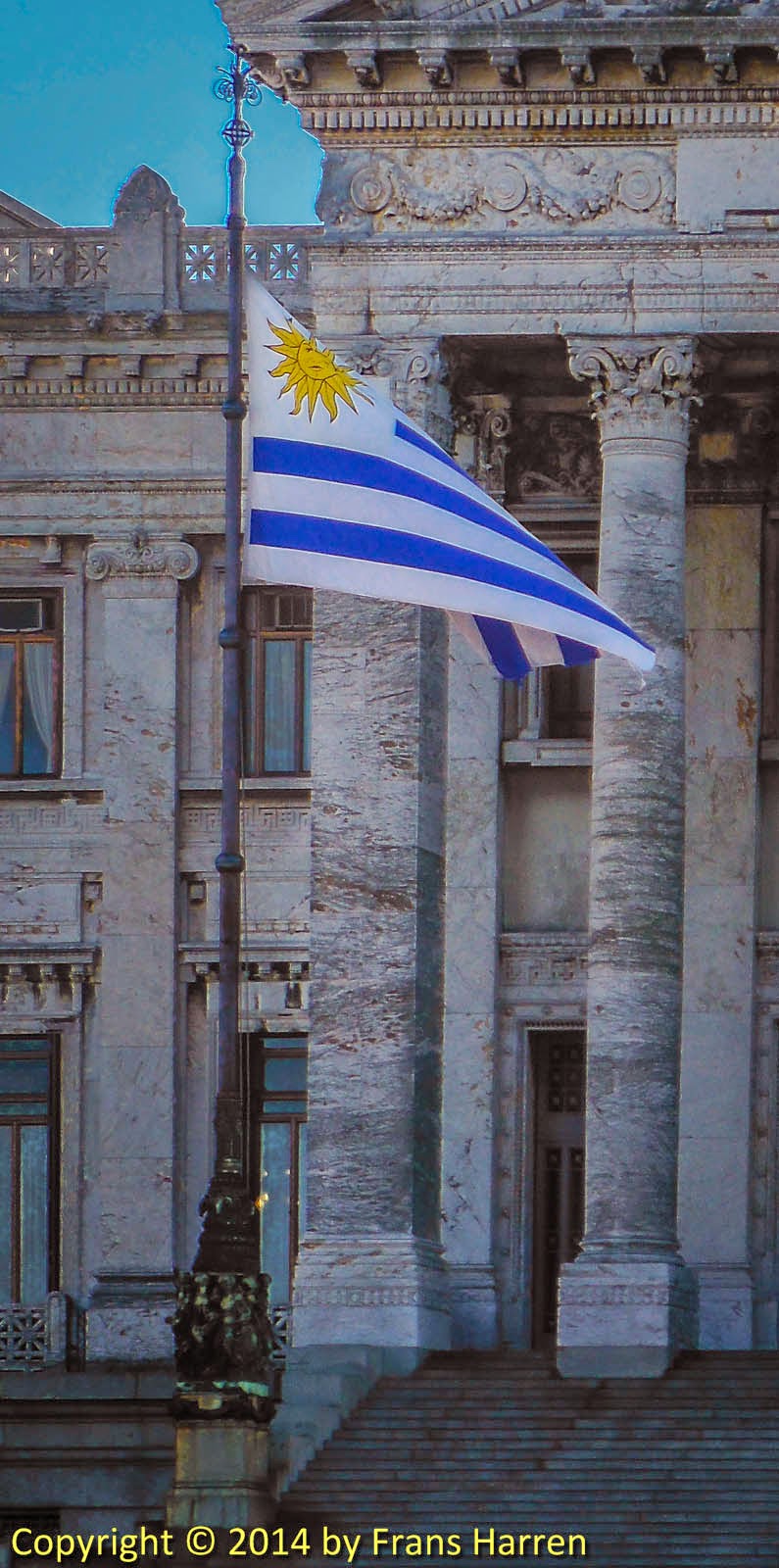
National flag of Uruguay in front of the parliament
National flag of Uruguay

National flag of Uruguay

The national flag of Uruguay (Pabellón Nacional) has a field of nine equal horizontal stripes alternating white and blue. The canton is white, charged with the Sun of May, from which 16 rays extend, alternating between triangular and wavy. The flag was first adopted by law on December 16, 1828 and had 17 stripes until July 11, 1830, when a new law reduced the number of stripes to nine. The flag was designed by Joaquín Suárez.

Symbolism and design

The horizontal stripes on the flag represent the nine original departments of Uruguay. The first flag designed in 1828 had 9 light blue stripes; this number was reduced to 4 in 1830 before the proclamation of the country's first Constitution. The Sun of May represents a new nation in the world.

See: wikipedia


22 March 2014


Solís Theatre, Montevideo

Solís Theatre

Solis Theatre is Uruguay's oldest theatre. It was built in 1856 and is currently owned by the government of Montevideo. It is located in Plaza Independencia (Ciudad Vieja).

In 1998, the government of Montevideo started a major reconstruction of the theatre, which included two US $110,000 columns designed by Philippe Starck. The reconstruction was completed in 2004 with the re-opening taking place in August of that year. Acoustic studies of the rehabilitation project was entrusted to Jerome Falala of the French studio AVEL ACOUSTIQUE.

Tomás Giribaldi's La Parisina, considered the first Uruguayan national opera, was premiered at the Solís on September 14, 1878.

See: wikipedia


Executive Tower, Montevideo

Torre Ejecutiva, Montevideo

Executive Tower is the name of the working place of the President of Uruguay. The original project was started in 1965 as a future Palace of Justice, but the 1973 coup d'état interrupted it.

By the time the military government ended in 1985, the building was too small for the Uruguayan justice system, so the project remained halted for decades until in March 2006, President Tabaré Vázquez decided to finish the building and use it as an extension of the Estévez Palace. The President's offices were transferred there from the Liberty Building in September 2009.

Despite the name, the building does not actually belong to the Presidency of Uruguay, but to a fully government-owned company called Legader S.A., which is in charge of leasing office space to other public and private organizations to finance the works on the building.

See: wikipedia


Fountain on Plaza Independencia, Montevideo

Plaza Independencia, Montevideo

Plaza Independencia (Spanish for Independence Square) is the name of Montevideo's most important plaza. It separates Ciudad Vieja from downtown Montevideo, with the Gateway of The Citadel on one side and the beginning of 18 de Julio avenue on the other.

In the center, the Artigas Mausoleum dominates the perspective.

Many important buildings, such as the Solís Theatre and the workplaces of the President of Uruguay (both the Estévez Palace and the Executive Tower) are located by this square.

One of the characteristic buildings located by the square is Palacio Salvo.

See: wikipedia


Plaza Independencia, Montevideo

Plaza Independencia, Montevideo

Plaza Independencia (Spanish for Independence Square) is the name of Montevideo's most important plaza. It separates Ciudad Vieja from downtown Montevideo, with the Gateway of The Citadel on one side and the beginning of 18 de Julio avenue on the other.

In the center, the Artigas Mausoleum dominates the perspective.

Many important buildings, such as the Solís Theatre and the workplaces of the President of Uruguay (both the Estévez Palace and the Executive Tower) are located by this square.

One of the characteristic buildings located by the square is Palacio Salvo.

See: wikipedia


Sunrise view of Artigas statue and Palacio Salvo, Montevideo

Artigas Mausoleum

The Artigas Mausoleum is a monument to Uruguayan hero José Artigas, located in Plaza Independencia, in the neighbourhood of Ciudad Vieja, Montevideo. It was built in the 1930s and Artigas's remains are kept in an underground room underneath the statue. The moument is guarded by a traditional guard called "Blandegues de Artigas".

See: wikipedia

José Gervasio Artigas

José Gervasio Artigas Arnal (June 19, 1764 – September 23, 1850) is a national hero of Uruguay, sometimes called "the father of Uruguayan nationhood". His portrait is on the watermark on the 1998 Uruguay 5 Pesos Uruguayos banknote.

Early life

Artigas was born in Montevideo on June 19, 1764. His grandparents were from Zaragosa, Buenos Aires and Tenerife (Canary Islands). His grandparents fought in the War of the Spanish Succession and moved to the Americas to escape from poverty, settling in Buenos Aires in 1716. Artigas was the son of Martín José Artigas and Francisca Antonia Arnal, who came from a wealthy family. His parents enrolled him in the Colegio de San Bernardino, to pursue religious studies, but Artigas refused to submit to the school's strict discipline. Before he left the school, he developed a strong friendship with Fernando Otorgues, who would work with him in later years. At the age of 12, he moved to the countryside and worked on his family's farms. His contact with the customs and perspectives of gauchos made a great impression on him. Once he had come of age, he distanced himself from his parents and became involved in cattle smuggling. This made him a wanted man among the owners of haciendas and with the government in Montevideo. A reward was put out for his death.

Things changed with the opening of the Anglo-Spanish War, and the threat of a British attack upon the viceroyalty. The viceroy Antonio de Olaguer y Feliú negotiated a pardon with his family, on the condition that he joined the Corps of Blandengues with a hundred men, to form a battalion. Thus, he began his military career in 1797, at age 33, with the rank of lieutenant. The attack finally came in 1806, when William Beresford invaded Buenos Aires, in the first British invasions of the Río de la Plata. Although Artigas's unit was tasked with patrolling the frontier with Brazil, he requested to take part in the military expedition that Santiago de Liniers launched from Montevideo to drive the British out of Buenos Aires. His request was granted, and the British were defeated. After the liberation of Buenos Aires, he was tasked with returning to Montevideo and informing the governor Pascual Ruiz Huidobro of the result of the battle. A second British attack aimed to capture Montevideo, which was captured in the Battle of Montevideo. Artigas was taken prisoner, but he managed to escape and returned to the countryside. He organized groups of gauchos and began a guerrilla war against the invaders. The British tried to capture Buenos Aires a second time, but were defeated by the local armies, and returned Montevideo to Spanish control as part of the terms of capitulation. Artigas was promoted to captain in 1809.

Oriental revolution

The ideas of the Age of Enlightenment and the outbreak of the Peninsular War in Spain, along with the capture of King Ferdinand VII, generated political turbulence all across the Spanish Empire. The absence of the king from the throne (replaced by the French Joseph Bonaparte) and the new ideas of the Enlightenment sparked the Spanish American wars of independence, between patriots (who wanted to establish republics or constitutional monarchies) and royalists (who wanted to keep an absolute monarchy). Artigas, who thought that the gauchos were not treated well, supported the new ideas. Buenos Aires deposed the viceroy in 1810, during the May Revolution, replacing him with the Primera Junta. Mariano Moreno, secretary of war, wrote at the Operations plan that Artigas would be a decisive ally against the royalists in Montevideo, and called him for an interview. However, by the time Artigas arrived in Buenos Aires, Moreno had already left the government. He was still welcomed, but received little help. He was promoted to colonel and received some weapons, money and 150 men, very little to organize a rebellion at the Banda Oriental. This was the last time Artigas saw the city of Buenos Aires.

Spain declared Buenos Aires a rogue city, and appointed Montevideo as the new capital, with Francisco Javier de Elío as the new viceroy. The city had financial problems, and the measures taken by Elío to maintain the royalist armies were highly unpopular in the countryside. This allowed Artigas to channel the popular discontent against the colonial authorities. A hundred men met near the Asencio stream and made the cry of Asencio, a pronunciamiento against the viceroy. They captured many villages in the Banda Oriental, such as Mercedes, Santo Domingo, Colla, Maldonado, Paso del Rey, Santa Teresa and San José. They also captured Gualeguay, Gualeguaychú and Arroyo de la China, at the west of the Uruguay river.

Elío sent some soldiers to kill Artigas, who failed. Then, he sent Manuel Villagrán, a relative of Artigas, to offer him the pardon and appoint him general and military leader of the Banda Oriental if he gave up the rebellion. Artigas considered the offer an insult, and sent Villagrán prisoner to Buenos Aires.

Montevideo was soon surrounded by Artigas's forces. A Montevidean army tried to stop the patriots at the Battle of Las Piedras, but they were defeated, and the city was put to siege. José Rondeau, commanding forces from Buenos Aires, joined the siege. Artigas wanted to attack the city right away, but Rondeau thought that there would be less loss of lives by establishing a blockade and waiting for the city to surrender. However, the besiegers did not consider the naval forces of Montevideo, who kept the city supplied and enabled them to endure the blockade.

On the verge of defeat, Elío allied himself with Brazilian forces, requesting their intervention in the conflict. Dom Diogo de Sousa entered into the Banda Oriental, leading an army of five thousand men. This added to the defeat of Manuel Belgrano at the Paraguay campaign, the defeat of Juan José Castelli at the First Upper Peru campaign and the Montevidean naval blockade of Buenos Aires. Fearing a complete defeat, Buenos Aires signed a truce with Elío, recognizing him as the ruler of the Banda Oriental and half of Entre Ríos. Artigas felt the truce to be treasonous. He broke relations with the city, and lifted the blockade over Montevideo.

Artigas left the Banda Oriental and moved to Salto Chico, in Entre Ríos. All his supporters moved with him. This massive departure is known as the Oriental exodus.

The Supreme Director Gervasio Antonio de Posadas offered a reward of $6.000 for the capture of Artigas, dead or alive. The only consequence of this action was increased resentment of the orientals towards Buenos Aires. Several royalist leaders, such as Vigodet or Pezuela, sought an alliance with Artigas against Buenos Aires, but he rejected them: "I may not be sold, nor do I want more reward for my efforts than to see my nation free from the Spanish rule". Despite the deep disputes, Artigas was still eager to return to good terms with Buenos Aires, but only if the city accepted a national organization based on federalist principles.

Posadas sent two more armies to capture and execute Artigas, but they mutinied and joined the orientals. When the Artiguist influence expanded to Corrientes, Posadas sought to negotiate by accepting the autonomy of the provinces. Artigas accepted the terms, but clarified that such autonomy must not be understood as national independence. He did not want to secede the Banda Oriental from the United provinces, but to organize them as a confederation. Posadas, who supported the authority of Buenos Aires as the head of a centralized state, delayed the approval of the treaty.

Buenos Aires renewed the military actions against Montevideo. This time, the naval skills of William Brown helped to overcome the strength of the Montevidean navy, leading to the final defeat of the royalist stronghold. Carlos María de Alvear led the capture of Montevideo, and lured Artigas there by promising that he would turn over the city to the Oriental patriots. Alvear attacked them without warning at Las Piedras, but Artigas managed to escape from the trap.

Liga Federal

In 1814, Artigas organized the Liga de los Pueblos Libres (League of the Free Peoples), of which he was declared Protector. In the following year, he liberated Montevideo from the control of the "Unitarians" from Buenos Aires.

In 1815, Artigas attended the Proto-congress of the Independence of Argentina, held in Arrollo de la China (today known as Concepción del Uruguay). It was at this congress that the provinces of the Oriental Province (today the country of Uruguay), Córdoba, Corrientes, Entre Ríos, Misiones and Santa Fe declared themselves independent from Spain and formed the Liga Federal ("Federal League"). The Liga Federal invited other provinces of the former Viceroyalty of the Rio de la Plata to join them under a federal system.

In this congress, Artigas ratified the use of the flag created by Manuel Belgrano (which would later become the flag of the Argentine Republic), but added a diagonal festoon in red, the color of federalism in Argentina at that time.

Luso Brazilian invasion

The continued growth of influence and prestige of the Federal League frightened the governments in Buenos Aires (because of its federalism) and Portugal (because of its republicanism), and in August 1816, Portugal invaded the Eastern Province (with tacit complicity from Buenos Aires), with the intention of destroying Artigas and his revolution.

The Portuguese forces, led by Carlos Frederico Lecor, captured Artigas and his deputies and occupied Montevideo on 20 January 1817, but the struggle continued for three years in the countryside. Infuriated by Buenos Aires's passivity, Artigas declared war on Buenos Aires while he was losing to the Portuguese. His subordinates, members of the Federal League -- Francisco Ramírez, governor of Entre Ríos, and Estanislao López, governor of Santa Fe—managed to defeat the centralism of Buenos Aires. But hope for a new nation was short-lived; both commanders entered agreements with Buenos Aires that went against the principles of Artigas. They rebelled against him and left him to be crushed by the Portuguese.

Without resources and men, Artigas withdrew to Paraguay in September 1820. In Paraguay, Dr. Francia, the dictator, banished him to Candelaria. He then disappeared from the political life of the region. (B. Nahum).

After a long exile, he died in Paraguay in 1850, at age 86. It is said that Artigas, feeling himself to be near death, asked for a horse and died in the saddle, as a gaucho. His remains were buried and then re-interned at the Panteón Nacional in 1855. On the 19th of June, 1977, his remains were transferred to the Artigas Mausoleum in the centre of the Plaza Independencia.

See: wikipedia

Palacio Salvo

Salvo Palace is a building in Montevideo, Uruguay, located at the intersection of 18 de Julio Avenue and Plaza Independencia. It was designed by the architect Mario Palanti, an Italian immigrant living in Buenos Aires, who used a similar design for his Palacio Barolo in Buenos Aires, Argentina. Finished in 1928, Palacio Salvo stands 100 meter high with the antenna included.

The site was bought by the Salvo brothers for 650,000 Uruguayan pesos. It was built on the site where the Confiteria La Giralda was once located, a place renowned for being where Gerardo Matos Rodríguez wrote his tango La Cumparsita in 1917.

The original specifications, describing the details of the construction, describe a lighthouse at the top of the building, which was replaced by a set of antennas. The specifications stated “on the top part of the tower a lighthouse will be placed made by Salmoiraghi of Italy, with a parabolic mirror of 920 mm, reaching approximately 100 km, and a rotating 100 amp lamp”.

The building was originally intended to be a hotel, but this plan didn't work out, and it has since been occupied by a mixture of offices and private residences. The building has a height of 95 meter. While the set of antennas was at its top, its total height was 100 meter. The antennas were permanently removed in November 2012. For decades it was the tallest building in South America.

See: wikipedia


Statue of Uruguayan hero José Artigas

Artigas Mausoleum

The Artigas Mausoleum is a monument to Uruguayan hero José Artigas, located in Plaza Independencia, in the neighbourhood of Ciudad Vieja, Montevideo. It was built in the 1930s and Artigas's remains are kept in an underground room underneath the statue. The moument is guarded by a traditional guard called "Blandegues de Artigas".

See: wikipedia

José Gervasio Artigas

José Gervasio Artigas Arnal (June 19, 1764 – September 23, 1850) is a national hero of Uruguay, sometimes called "the father of Uruguayan nationhood". His portrait is on the watermark on the 1998 Uruguay 5 Pesos Uruguayos banknote.

Early life

Artigas was born in Montevideo on June 19, 1764. His grandparents were from Zaragosa, Buenos Aires and Tenerife (Canary Islands). His grandparents fought in the War of the Spanish Succession and moved to the Americas to escape from poverty, settling in Buenos Aires in 1716. Artigas was the son of Martín José Artigas and Francisca Antonia Arnal, who came from a wealthy family. His parents enrolled him in the Colegio de San Bernardino, to pursue religious studies, but Artigas refused to submit to the school's strict discipline. Before he left the school, he developed a strong friendship with Fernando Otorgues, who would work with him in later years. At the age of 12, he moved to the countryside and worked on his family's farms. His contact with the customs and perspectives of gauchos made a great impression on him. Once he had come of age, he distanced himself from his parents and became involved in cattle smuggling. This made him a wanted man among the owners of haciendas and with the government in Montevideo. A reward was put out for his death.

Things changed with the opening of the Anglo-Spanish War, and the threat of a British attack upon the viceroyalty. The viceroy Antonio de Olaguer y Feliú negotiated a pardon with his family, on the condition that he joined the Corps of Blandengues with a hundred men, to form a battalion. Thus, he began his military career in 1797, at age 33, with the rank of lieutenant. The attack finally came in 1806, when William Beresford invaded Buenos Aires, in the first British invasions of the Río de la Plata. Although Artigas's unit was tasked with patrolling the frontier with Brazil, he requested to take part in the military expedition that Santiago de Liniers launched from Montevideo to drive the British out of Buenos Aires. His request was granted, and the British were defeated. After the liberation of Buenos Aires, he was tasked with returning to Montevideo and informing the governor Pascual Ruiz Huidobro of the result of the battle. A second British attack aimed to capture Montevideo, which was captured in the Battle of Montevideo. Artigas was taken prisoner, but he managed to escape and returned to the countryside. He organized groups of gauchos and began a guerrilla war against the invaders. The British tried to capture Buenos Aires a second time, but were defeated by the local armies, and returned Montevideo to Spanish control as part of the terms of capitulation. Artigas was promoted to captain in 1809.

Oriental revolution

The ideas of the Age of Enlightenment and the outbreak of the Peninsular War in Spain, along with the capture of King Ferdinand VII, generated political turbulence all across the Spanish Empire. The absence of the king from the throne (replaced by the French Joseph Bonaparte) and the new ideas of the Enlightenment sparked the Spanish American wars of independence, between patriots (who wanted to establish republics or constitutional monarchies) and royalists (who wanted to keep an absolute monarchy). Artigas, who thought that the gauchos were not treated well, supported the new ideas. Buenos Aires deposed the viceroy in 1810, during the May Revolution, replacing him with the Primera Junta. Mariano Moreno, secretary of war, wrote at the Operations plan that Artigas would be a decisive ally against the royalists in Montevideo, and called him for an interview. However, by the time Artigas arrived in Buenos Aires, Moreno had already left the government. He was still welcomed, but received little help. He was promoted to colonel and received some weapons, money and 150 men, very little to organize a rebellion at the Banda Oriental. This was the last time Artigas saw the city of Buenos Aires.

Spain declared Buenos Aires a rogue city, and appointed Montevideo as the new capital, with Francisco Javier de Elío as the new viceroy. The city had financial problems, and the measures taken by Elío to maintain the royalist armies were highly unpopular in the countryside. This allowed Artigas to channel the popular discontent against the colonial authorities. A hundred men met near the Asencio stream and made the cry of Asencio, a pronunciamiento against the viceroy. They captured many villages in the Banda Oriental, such as Mercedes, Santo Domingo, Colla, Maldonado, Paso del Rey, Santa Teresa and San José. They also captured Gualeguay, Gualeguaychú and Arroyo de la China, at the west of the Uruguay river.

Elío sent some soldiers to kill Artigas, who failed. Then, he sent Manuel Villagrán, a relative of Artigas, to offer him the pardon and appoint him general and military leader of the Banda Oriental if he gave up the rebellion. Artigas considered the offer an insult, and sent Villagrán prisoner to Buenos Aires.

Montevideo was soon surrounded by Artigas's forces. A Montevidean army tried to stop the patriots at the Battle of Las Piedras, but they were defeated, and the city was put to siege. José Rondeau, commanding forces from Buenos Aires, joined the siege. Artigas wanted to attack the city right away, but Rondeau thought that there would be less loss of lives by establishing a blockade and waiting for the city to surrender. However, the besiegers did not consider the naval forces of Montevideo, who kept the city supplied and enabled them to endure the blockade.

On the verge of defeat, Elío allied himself with Brazilian forces, requesting their intervention in the conflict. Dom Diogo de Sousa entered into the Banda Oriental, leading an army of five thousand men. This added to the defeat of Manuel Belgrano at the Paraguay campaign, the defeat of Juan José Castelli at the First Upper Peru campaign and the Montevidean naval blockade of Buenos Aires. Fearing a complete defeat, Buenos Aires signed a truce with Elío, recognizing him as the ruler of the Banda Oriental and half of Entre Ríos. Artigas felt the truce to be treasonous. He broke relations with the city, and lifted the blockade over Montevideo.

Artigas left the Banda Oriental and moved to Salto Chico, in Entre Ríos. All his supporters moved with him. This massive departure is known as the Oriental exodus.

The Supreme Director Gervasio Antonio de Posadas offered a reward of $6.000 for the capture of Artigas, dead or alive. The only consequence of this action was increased resentment of the orientals towards Buenos Aires. Several royalist leaders, such as Vigodet or Pezuela, sought an alliance with Artigas against Buenos Aires, but he rejected them: "I may not be sold, nor do I want more reward for my efforts than to see my nation free from the Spanish rule". Despite the deep disputes, Artigas was still eager to return to good terms with Buenos Aires, but only if the city accepted a national organization based on federalist principles.

Posadas sent two more armies to capture and execute Artigas, but they mutinied and joined the orientals. When the Artiguist influence expanded to Corrientes, Posadas sought to negotiate by accepting the autonomy of the provinces. Artigas accepted the terms, but clarified that such autonomy must not be understood as national independence. He did not want to secede the Banda Oriental from the United provinces, but to organize them as a confederation. Posadas, who supported the authority of Buenos Aires as the head of a centralized state, delayed the approval of the treaty.

Buenos Aires renewed the military actions against Montevideo. This time, the naval skills of William Brown helped to overcome the strength of the Montevidean navy, leading to the final defeat of the royalist stronghold. Carlos María de Alvear led the capture of Montevideo, and lured Artigas there by promising that he would turn over the city to the Oriental patriots. Alvear attacked them without warning at Las Piedras, but Artigas managed to escape from the trap.

Liga Federal

In 1814, Artigas organized the Liga de los Pueblos Libres (League of the Free Peoples), of which he was declared Protector. In the following year, he liberated Montevideo from the control of the "Unitarians" from Buenos Aires.

In 1815, Artigas attended the Proto-congress of the Independence of Argentina, held in Arrollo de la China (today known as Concepción del Uruguay). It was at this congress that the provinces of the Oriental Province (today the country of Uruguay), Córdoba, Corrientes, Entre Ríos, Misiones and Santa Fe declared themselves independent from Spain and formed the Liga Federal ("Federal League"). The Liga Federal invited other provinces of the former Viceroyalty of the Rio de la Plata to join them under a federal system.

In this congress, Artigas ratified the use of the flag created by Manuel Belgrano (which would later become the flag of the Argentine Republic), but added a diagonal festoon in red, the color of federalism in Argentina at that time.

Luso Brazilian invasion

The continued growth of influence and prestige of the Federal League frightened the governments in Buenos Aires (because of its federalism) and Portugal (because of its republicanism), and in August 1816, Portugal invaded the Eastern Province (with tacit complicity from Buenos Aires), with the intention of destroying Artigas and his revolution.

The Portuguese forces, led by Carlos Frederico Lecor, captured Artigas and his deputies and occupied Montevideo on 20 January 1817, but the struggle continued for three years in the countryside. Infuriated by Buenos Aires's passivity, Artigas declared war on Buenos Aires while he was losing to the Portuguese. His subordinates, members of the Federal League -- Francisco Ramírez, governor of Entre Ríos, and Estanislao López, governor of Santa Fe—managed to defeat the centralism of Buenos Aires. But hope for a new nation was short-lived; both commanders entered agreements with Buenos Aires that went against the principles of Artigas. They rebelled against him and left him to be crushed by the Portuguese.

Without resources and men, Artigas withdrew to Paraguay in September 1820. In Paraguay, Dr. Francia, the dictator, banished him to Candelaria. He then disappeared from the political life of the region. (B. Nahum).

After a long exile, he died in Paraguay in 1850, at age 86. It is said that Artigas, feeling himself to be near death, asked for a horse and died in the saddle, as a gaucho. His remains were buried and then re-interned at the Panteón Nacional in 1855. On the 19th of June, 1977, his remains were transferred to the Artigas Mausoleum in the centre of the Plaza Independencia.

See: wikipedia


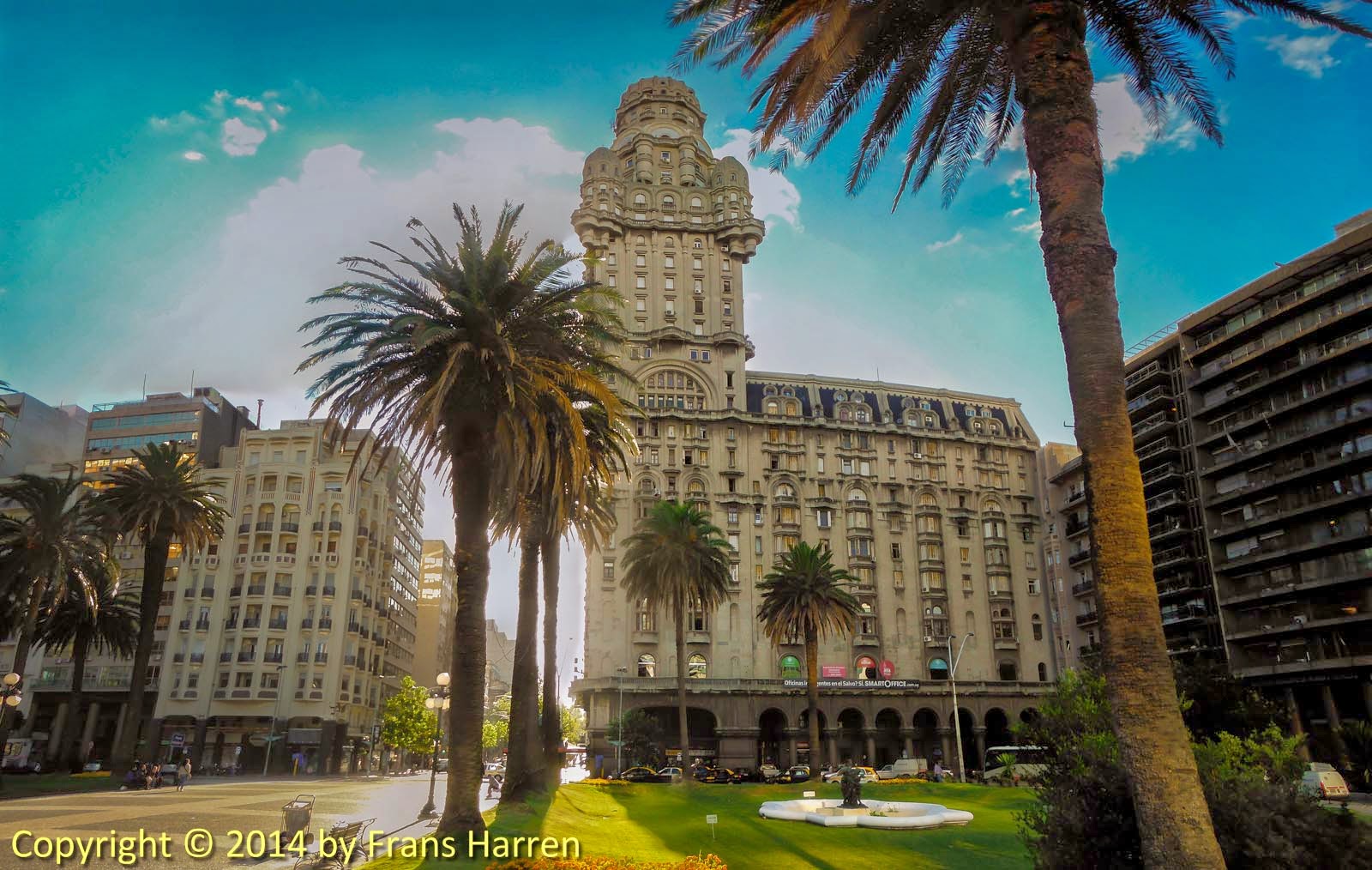
Palacio Salvo, Montevideo

Palacio Salvo

Salvo Palace is a building in Montevideo, Uruguay, located at the intersection of 18 de Julio Avenue and Plaza Independencia. It was designed by the architect Mario Palanti, an Italian immigrant living in Buenos Aires, who used a similar design for his Palacio Barolo in Buenos Aires, Argentina. Finished in 1928, Palacio Salvo stands 100 meter high with the antenna included.

The site was bought by the Salvo brothers for 650,000 Uruguayan pesos. It was built on the site where the Confiteria La Giralda was once located, a place renowned for being where Gerardo Matos Rodríguez wrote his tango La Cumparsita in 1917.

The original specifications, describing the details of the construction, describe a lighthouse at the top of the building, which was replaced by a set of antennas. The specifications stated “on the top part of the tower a lighthouse will be placed made by Salmoiraghi of Italy, with a parabolic mirror of 920 mm, reaching approximately 100 km, and a rotating 100 amp lamp”.

The building was originally intended to be a hotel, but this plan didn't work out, and it has since been occupied by a mixture of offices and private residences. The building has a height of 95 meter. While the set of antennas was at its top, its total height was 100 meter. The antennas were permanently removed in November 2012. For decades it was the tallest building in South America.

See: wikipedia